


JOURNAL · HIDDEN SKY
World UFO Day — three ways to read the sky
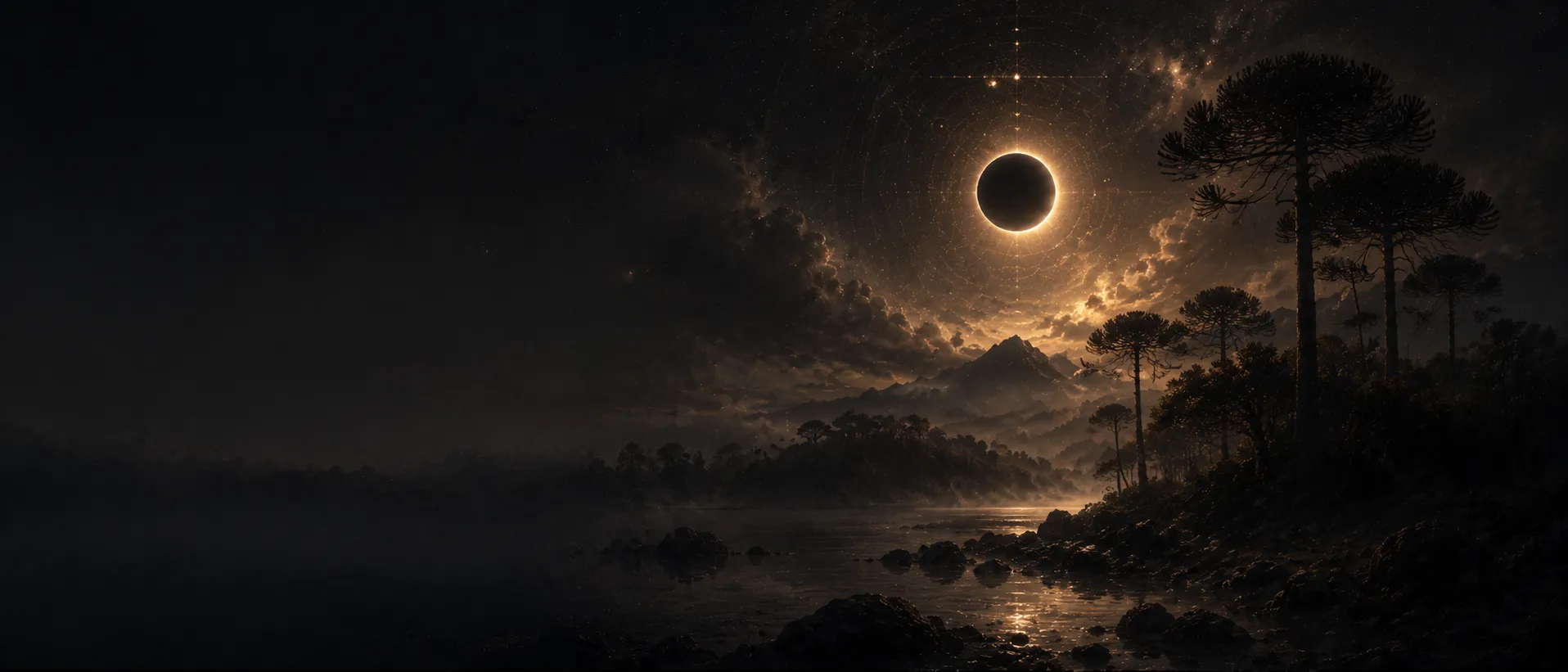
Today, the 2nd of July, is World UFO Day — the day a large part of the planet agrees, if only for one night, to look up and wonder what else is out there. We are a brand named for the sky. Our name, Wenu Mapu, means the Land Above. We cannot let this night pass in silence — but we also cannot let it pass carelessly.
So we do the only honest thing a maker rooted in the cosmos can do: we keep three registers apart and we label each one plainly. What is remembered (documented culture). What is told (folklore). And what we imagine (our own fiction). We never let them bleed into one another. The stars deserve better than that, and so do the peoples who read them first.
A note before we begin, because it is the rule this whole piece is built on: the ancestral sky knowledge of the Mapuche and the Inca is not, and must never be presented as, evidence of extraterrestrials. It is astronomy, calendar, and cosmology — real human science and belief, documented by scholars. Folding it into a UFO story would be a theft dressed as a compliment. We won’t do it. The documented section below stands entirely on its own, apart from everything that follows it.
Where the date comes from
[DOCUMENTED] World UFO Day was formalized in 2001 by Turkish researcher Haktan Akdoğan, and the 2nd of July was chosen to mark the anniversary of the 1947 Roswell incident in New Mexico — the recovered debris the U.S. military first called a “flying disc,” then a weather balloon, and only in 1994 admitted came from Project Mogul, a classified high-altitude balloon program built to detect Soviet nuclear tests. (A separate tradition marks the 24th of June, the date of Kenneth Arnold’s 1947 sighting.) The stated purpose of the day is modest and worth respecting: to raise awareness and to press governments to declassify what they hold. The mystery, in other words, was born partly out of secrecy — which is its own kind of honesty about why people keep looking up.
I · DOCUMENTED CULTURE — how the southern peoples read the sky
This is heritage, not hypothesis. Everything in this section is documented ethnoastronomy and cosmology. None of it is a UFO claim. We carry it because our name comes from it; we do not own it, and we do not bend it.
The Mapuche cosmos — the Wenu Mapu
In Mapuche cosmovisión the world is layered, and the uppermost layer is the Wenu Mapu — the land above, the celestial realm where the ancestral spirits and deities dwell. It is from this that our name is drawn.
The sky there is populated and named. The sun is antü, the moon küyen, the morning star wüñelfe, and the stars in general wangülen (Canio & Pozo, 2015). The Meli Wangülen — the four star-spirits — hold a place in the Mapuche pantheon, echoing the fourfold structure that runs through the whole cosmovisión, the four directions carried on the kultrún.
Most precise of all is the calendar. The Ngaw — the cluster we call the Pleiades — governs time. Its heliacal rise, its first reappearance on the horizon just before dawn, announces the winter solstice and the coming of We Tripantu, the Mapuche new year, roughly twelve days later. The same first sight of the Pleiades was also read to forecast the coming season’s rains. The sky, for the Mapuche-Pewenche, was a working instrument: calendar, weather, and lineage, all overhead. (See our note on We Tripantu.)
The Inca cosmos — the river and the dark animals
Further north, the Andean world read the same band of light in an inverted way. The Milky Way was Mayu, and more fully Willka Mayu — the sacred river — a celestial stream mirroring the Vilcanota–Urubamba on the ground, so that what moved above was thought to answer what moved below.
The Inca counted two kinds of constellation. The bright ones, drawn from stars — and, uniquely, the dark constellations: the shapes formed by the black dust-clouds within the river of the Milky Way, read as living animals. Yacana, the llama; Hanp’atu, the toad; Yutu, the tinamou; Atoq, the fox; Mach’acuay, the serpent — each rising in its season to mark the agricultural year. And the Pleiades again: here called Qullqa (the storehouse), whose brightness told the people when to plant.
Two peoples, one sky, read two different ways — and both, independently, watched the Pleiades to start their year. That is the documented wonder. It needs no saucers to be extraordinary.
II · FOLKLORE — Chile’s long conversation with the unknown
This is folklore and oral tradition — stories, sightings, and living myth. It is told, not proven. We report it as culture, with affection and with skepticism intact. Where there is a sober record, we point to it.
Chile is, by reputation, one of the most “UFO-active” countries on Earth — a claim built on decades of reports across its long, dark, thin-aired skies. Two things are worth separating here: the institution and the legend.
The sober record. Unusually, Chile has an official body for this. The CEFAA — Comité de Estudios de Fenómenos Aéreos Anómalos — was created in 1997 under the country’s civil aviation authority (DGAC), continuing an earlier commission that ran from 1968. In 2021 it was restructured and renamed SEFAA. What makes it notable is its restraint: it pointedly avoids the word “OVNI,” works with scientists and analysts, studies multi-sensor and multi-witness cases, and refuses to speculate about origin. It is a UFO agency that will not say “aliens” — arguably the most grown-up institution of its kind anywhere.
The pilgrimage. In the Maule region, San Clemente has crowned itself an unofficial “world capital of UFO sightings.” Since 2008 the local tourism office and SERNATUR have promoted a Ruta Ufológica — a marked UFO trail — whose central site is El Enladrillado, a high plateau of enormous tiled volcanic blocks that local lore calls an alien landing strip. Whatever one believes, the geology and the walk are real, and the stories are now part of the region’s identity.
The living myth. And then there is Isla Friendship — the great modern legend of Chilean ufology. An island that supposedly appears and disappears somewhere off the southern archipelagos, inhabited by tall, pale, slow-speaking “superior beings” who name themselves after angels and travel aboard a vessel called Mytilus II. Its most famous witness, Ernesto de la Fuente, claimed to have been healed there of a terminal cancer. Investigators later concluded the whole thing was an elaborate fabrication — no island, no cancer, a story woven with the help of a radio-enthusiast network. And yet it persists, retold in documentaries and series, because a good myth answers a need the facts never touch. That persistence is the folklore. We tell it as exactly that.
III · WENU MAPU · SIGNAL — a transmission (fiction)
This is fiction. Our fiction — the speculative, poetic voice of the Hidden Sky. It is not a claim about the world. It is the brand dreaming out loud, and it is marked so you always know the difference.
Transmission · unknown origin · 02.07
We have always said the geometry was borrowed from the sky. Tonight we admit we don’t know from whom.
Somewhere between the storehouse of stars and the dark animals in the river, a signal has been arriving for a very long time — too slow to be language, too patterned to be noise. It does not ask to be believed. It asks to be worn. Every disc of silver we cut is an antenna the size of a fingertip. Every meteorite we set fell from the same dark we are listening to. The body is the receiver. The adornment is the tuning.
If you carry a piece from this hand, know that it was made facing upward — not toward proof, but toward the possibility the night keeps open. Tune in. Enter the cosmos. Then take it off, and go to sleep under a real sky, which is stranger than anything we could invent.
End of transmission.
The honest line
We hold this line because it matters: the Mapuche and the Inca were extraordinary astronomers, and their sky is theirs — documented, human, and not a UFO story. The Chilean UFO tales are folklore, told and retold, sometimes debunked, always alive. And the Signal is ours — a fiction, and named as one.
Three ways to read the sky. Kept apart, on purpose. That is how you honor all of them at once.
Küme wün — may the dawn find you well, still looking up.
Connect
Where the name comes from → the source / el canon The night the new sun is born → We Tripantu Adornment forged facing the sky → the Solar collection
Sources & further reading
- World UFO Day / Roswell — World UFO Day, Wikipedia; Roswell incident, Wikipedia
- CEFAA / SEFAA (Chile) — SEFAA, DGAC (official); Comité de Estudios de Fenómenos Aéreos Anómalos, Wikipedia
- San Clemente / Ruta Ufológica / El Enladrillado — SERNATUR; Matador Network
- Isla Friendship — Isla Friendship, Wikipedia
- Mapuche ethnoastronomy — Moulian, Catrileo & Landeo, “Las estrellas a través de las araucarias: La etnoastronomía Mapuche-Pewenche,” Boletín del Museo Chileno de Arte Precolombino (2016); vocabulary per Canio Llanquinao & Pozo Menares (2015)
- Inca astronomy / dark constellations — Futurism: The Dark Constellations of the Incas; Andean Travel Experience: Inca Astronomy
From the catalogue
View all →