JOURNAL · PROCESS
Casting the meteorite
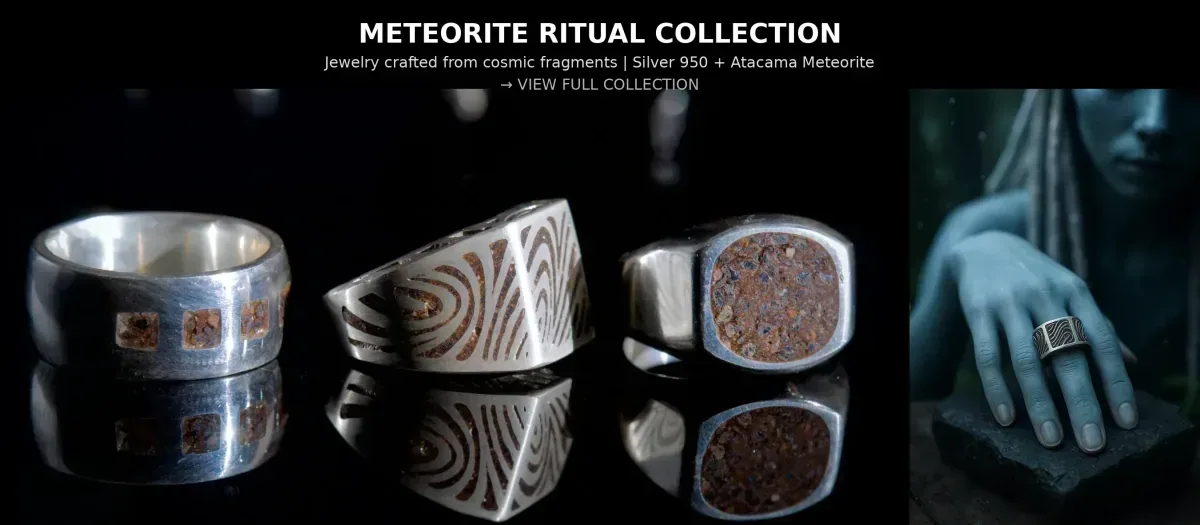
A finished Vacamuerta ring takes about six weeks. Only a fraction of that is active hand work; the rest is waiting — for an etch to develop, for an alloy to cool, for a weather window dry enough for a final polish. The rings are hand-cast by Jimmy, the artisan who makes Wenu Mapu’s Atacama meteorite series.
This is what those six weeks look like at his bench.
Week 1 — Tablet selection
A meteorite fragment arrives as an irregular piece, somewhere between the size of a walnut and a fist. Jimmy weighs it, photographs it from every angle, and documents the find region from its certificate of provenance.
Then he cuts. A diamond saw, slow feed, plenty of coolant. The cut produces a tablet — usually 2 to 4 millimeters thick, with the broad face of the slice exposed for the next steps. The fragment that remains is set aside for future tablets; nothing is wasted.
The tablet is rough at this stage — saw marks, dull surface, no hint yet of what is inside.
Week 2 — Surface preparation
The cut face gets a sequence of finer and finer abrasive treatments. Jimmy starts with a coarse silicon-carbide paper and steps down through grits — 220, 400, 800, 1500, 3000 — until the surface reads as a slightly cloudy mirror.
This is the most patient step. Pressing too hard on meteorite metal produces friction heat that can damage the crystalline structure. Each grit takes 20 to 40 minutes of hand work. By the end of the week, the tablet looks, briefly, like a featureless gray mirror. You would not yet guess what is inside.
Week 3 — The etch
The crystalline pattern emerges only when the polished surface is etched with a mild acid — typically a dilute solution of nitric acid in alcohol, called nital. Jimmy applies it carefully with a soft brush. The acid reacts differently with the metallic phases inside the meteorite, revealing a structure that formed inside the parent body as it cooled across cosmic time.
The pattern that surfaces is not invented. It was waiting there. He is the first person to see it on this particular fragment.
After the etch, the tablet is rinsed in distilled water, neutralized in a weak baking-soda bath, dried, and sealed against further oxidation with a thin microcrystalline wax. The wax is breath-thin. It does not affect how the piece looks; it slows the future patina.
Week 4 — Casting the band
While the meteorite tablet is curing, Jimmy builds the metal that will hold it — by lost-wax casting. He carves a wax pattern to the profile of the ring (for a Vacamuerta piece, usually a wide-band signet), invests it in plaster, burns the wax out, and casts the band in sterling silver 950 or 14k gold. Once the cast band is cleaned of its sprue and sized to the wearer, a bezel is fabricated from sheet to fit the exact dimensions of the tablet.
The setting is hand-finished before the meteorite goes in: the band is polished, the bezel is filed clean, any decorative work (a textured face, a cardinal cross stamp on the inside, a stippled texture under the bezel) is completed. Once the meteorite is set, the setting cannot be polished aggressively without risking the tablet.
Week 5 — Setting
Setting a Vaca Muerta meteorite tablet into the cast band is delicate. The bezel is gently pushed over the perimeter of the tablet, mil by mil, with a curved burnisher — never hammered. Heat from soldering would damage the meteorite, so any soldering is done before the tablet is in place. The pressure is read by feel: enough to hold the tablet against any motion, not enough to crack the brittle crystalline edge.
Once the bezel is set, a final inspection: Jimmy looks at the piece under a 10x loupe and checks for any uneven gap between bezel and tablet, any stress mark on the surface, any small contamination from the setting process. If anything is wrong, he stops. Setting failures are real; a piece has been refused over a tenth-of-a-millimeter gap.
Week 6 — Final finish, photography, and packing
The setting is given a final hand polish — areas around the bezel, the inner band, the edges. The piece is cleaned and photographed for the catalogue listing in north-facing daylight. The certificate of authenticity is printed, signed, and packed with the ring.
The piece ships.
What this six weeks teaches
You cannot rush a Vacamuerta piece. The material was 4.5 billion years in the making; six weeks at the end is the smallest amount of patience that respects what was given.
This is also why these pieces are limited. Every fragment is different. Every tablet carries a different lattice. Every ring is, in the most literal sense, one of a kind.
Browse and commission
Browse pieces with Vacamuerta in the catalogue → /material/vacamuerta Commission a custom Vacamuerta piece → /custom-orders Read about our broader artistry → /artistry